Good people welcomed.
“[Man] is not likely to salvage civilization unless he can evolve a system of good and evil which is independent of heaven and hell.” — George Orwell, “As I Please,” Tribune, March 3, 1944
Are you trying to be good and make the world better, only to find everyone arguing past each other, making enemies of people who should be friends? Are you shocked by how little goodwill seems to be left? Are you afraid to befriend or defend someone with different views, for fear of being ostracized yourself?
You’re not alone. And it doesn’t have to be this way. What if:
- People talked with each other to find common ground, working toward a common Good?
- Society offered cohesiveness based on love, wisdom, and community, without the misogyny, war, corruption, and useless dogma?
- Morality was logical and reasonable right down to its core, but still made room for imagination, compassion, love, and ample goodwill?
- Your community gave you real tools for the real world, including a place to voice your opinions free of trolls and without fear of being ostracized?
…And what if it all got better over time, by design?
That’s what Humanism offers. Humanist.com is a nonprofit social community, shared with Agnostic.com, built on understanding, inclusion, love, and activism, where the values of Humanism aren’t just encouraged; they’re required and enforced.
Humanism is not a religion, but parts of it sit at the core of every one of the world’s religions, under the guise of “divine morality.” Take any religion and strip away the dogma, and what’s left is purely reasonable Humanist ideals. We just need the tools to find that Humanism, regrow it, and delight in it.
We seek to reduce net suffering and increase the length and quality of life on Earth as a single, practical, objective moral Good. Grounded in science, and aware that weighing sentience against suffering takes judgment calls, we are united by one idea:
- Every living thing that can feel suffering avoids it, to the degree it can perceive it. So we call suffering objectively bad, and the overall reduction of suffering an objective good.
- We can reduce the suffering of others. So an objectively good purpose of life is to improve the lives of others. If we can defend a Practically-objective Good, we can derive an equally practical, objective purpose of life.
We don’t ask for obedience, tithing, or even agreement; open, civil debate is how ideas get tested and improved. And we certainly don’t ask for blind faith. We do ask that you try to be good and encourage others to do the same. Here, that means you ALWAYS try to be civil and to see the people you talk with as whole people, not just their opinions. We hope you take that everywhere else, too. Come join us: to belong, to be good, and to be happy!
“I Am a Humanist”… Means What?
There is only one primary rule in Humanism: try to advance Goodness by increasing well-being and reducing suffering. Everything else follows from it. Humanism starts from the idea that “there is Good in everyone… even if it’s wrapped in problems,” and that makes us teammates on the side of Good.
Humanism teaches us to:
- See that someone with a different worldview is not “evil” or less human, but most likely a good person trying to reduce suffering and increase well-being as they see it, through their own perception filters.
- Stay humble, knowing that we all suffer from cognitive dissonance and misplaced confidence.
- Give naysayers and most wrongdoers a path to transformation and redemption, so we keep a cohesive, diverse society that challenges our blind spots.
- Use civil discourse as a weapon against bad ideas, not as a courtesy offered to the extremists who hold them.
- Remember that dehumanization is both natural and bad for us, and that humanizing others is a never-ending fight between our tribal instincts and the Common Good.
Unlike religion’s fixed dogma, Humanism offers a logical, reality-based morality designed to reunite humanity. Its “virtues” (kindness, charity, generosity, skepticism, forgiveness) and “vices” (blind faith, malice, bigotry, oppression) rest on things we can check: good can be shown to be good, and bad shown to be bad, by how they affect the quality and length of life of all people, and even other animals. Our job is to keep asking whether our actions really are good.
What is Dogma?
Dogma is “a principle or set of principles laid down by an authority as incontrovertibly true.” It’s very useful if you’re in power, because it lets you make demands that can never be questioned. As a guide to right and wrong, it starts out poor (that was never its real purpose) and gets worse as the world moves on and dogma stands still. That’s why some religious sects reject progress in favor of misogyny, xenophobia, anti-LGBTQ hatred, and other thinking the rest of society has left behind.
Our “undogma” offers a logical, defensible moral structure to live by and to teach children, one that leads to fuller, richer, longer lives. It needs no “mysterious ways” and no “or else you’ll burn in Hell” to paper over inconsistencies (Why would a benevolent God create evil? Why doesn’t God just stop Satan?), because there are none to paper over!
Question a tenet of Humanism (say, “it’s good to reduce suffering”) and the discussion begins. That’s a feature, not a bug. Humanism evolves with society’s morality, which is why Humanists support civil rights, gender equality, and the separation of church and state, ideals many religions still resist because their dogma cannot change.
Humanism teaches us to humanize each other. Humans are social animals, like chimpanzees, dolphins, and whales. We evolved empathy and compassion because groups survive longer when their members care for each other and gather resources together.
But the same evolution gave us outgrouping: tribalism. A tribe thrives on cohesion and compassion inside and indifference toward competing tribes, even if they suffer and die as a result. Tribalism runs on shared fear, mistrust, and hatred of a common enemy. Once that enemy is dehumanized, it’s easy to see them as undeserving of kindness, or even humane treatment. That instinct switches off our compassion for outsiders, and it leads to war and other atrocities.
Most people, even those with distasteful opinions, are complex people with their own life experiences and perspectives. Humanization is the antidote to hate because it inoculates us against prejudice and hostile outgrouping in all its forms: bullying, sexism, racism, misogyny, ageism, homophobia, transphobia, ableism, and xenophobia.
Write someone off as evil or “just stupid,” even when their views are wrong or horrible, and they will shut down, dig in, and stop hearing you. They won’t learn, and Good won’t advance. It works far better to start with the goals and needs you share and treat the other person as a human being. Agree on a common good, disagree only on how to get there, and enemies can become allies.
This doesn’t deny that some people are bad and need to be separated from society. A murderer should be removed until they are no longer a threat. But good people can be wrong too, and they should be treated as good, wrong people, not evil outcasts.
Humanism reminds us that civil discourse is a valuable weapon against weak or wrong arguments, not something you do to be nice to your opponent. Reasoned, logical argument grows everyone’s shared knowledge, and it beats vitriol and hate every time.
Humanism insists that justice include a path to transformation, not just punishment. Misdeeds are committed by complex people for complex reasons, not always by evil people out to do harm. When troubled or misguided people become better members of society, everyone wins, including them. So we practice mindful, earned forgiveness and redemption, not endless ostracism. Expel someone from society, or even just from your circle of friends, and resentment festers, planting the seeds of the next conflict.
Why Humanism Is Needed Today
Algorithmic social feeds thrive on conflict, so they serve us more of it. Facebook and Instagram, X, TikTok, and YouTube all watch what we like and what makes us angry, then tune our feeds so we keep coming back to fight those “other” people some more, selling ad space at the expense of civility itself. Their business rewards everyone dehumanizing everyone else, because their real product is our attention. The echo chambers we build with their tools keep that attention captive. Now AI-generated content and bots amplify the outrage too, cheaply and at enormous scale.
We aren’t like that here. We seek civil, constructive conflict resolution, humanization for everyone in every conflict, and personal growth for every member. We don’t avoid conflict, and we don’t make anyone pass a purity test. In fact, we expect everyone to fail at some point, work it out civilly, and remain a welcome, vibrant part of our community.
We also hold up redemption and forgiveness as hallmarks of Humanism; both follow directly from the Practically-objective Good. They’re also really hard. It’s much easier to stay angry or cut someone off. Forgiveness gets mistaken for condoning, and mercy for weakness. Redemption, even when earnestly sought, is rarely granted. We take the easy path so often that we’ve lost the skill of forgiving.
Internet culture normalizes ostracism and outgrouping. Buck the preferred narrative (that is, fail a purity test) and you may be shunned on the spot, ending the discussion. Dissenters are dehumanized, attacked as sympathizers, and pushed out, and onlookers grow afraid to support them. Even people who simply champion civil discourse are often shunned too. That’s how an echo chamber protects itself. Nobody likes being told they’re wrong (or worse, proven wrong), and echo chambers shield opinions, right or wrong, from debate.
Humanism keeps echo chambers from forming. Starting from the Practically-objective Good gives everyone common ground from the get-go, and a basis for arguing a point without attacking or dehumanizing the other side. Take two Humanists on opposite sides of “border protection.” First they agree that decreasing suffering and increasing well-being is good. Then each tries to show that their position does that better.
The Growth and Threat of Dehumanization
The Internet has made dehumanization easier than ever. Online life has permanently changed the way we interact, and we as a society have to change with it.
Until recently, life was built on face-to-face relationships. The people we knew were few, and often in our lives for good. We depended on a small group for all our social and support needs, so we humanized by default. We had no choice: we knew each other too well.
Now we have many “friends” with no close connection, and we measure social support in likes and comments, which carry far less information than a conversation. Someone may like a post just for the headline, while the poster takes it as support for the position itself.
“Friends” are also so plentiful that they’re disposable, and virtual purity tests are the norm. Fail one, even slightly, and you’re dehumanized, lumped in with everyone who shares that one view (“they’re a Nazi/bigot/idiot”), and unfriended, often along with your friends.
The result is an almost infinite splintering of society and the near-elimination of civil discourse, with mob justice and keyboard isolationism replacing any morality that serves today’s society. We now dehumanize by default; there often has to be a reason not to dehumanize someone! Sheltering in our echo chambers removes a corrective check on extremism, and the deplatforming of controversial speakers shows how this online phenomenon spills into real life.
How Splintering Happens
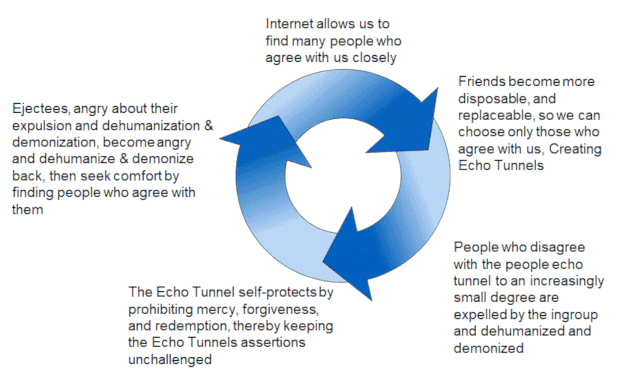
This rampant dehumanization has damaged the way we talk to each other. We’ve stopped listening, which shuts off any chance of transformation, forgiveness, or redemption. We’ve stopped seeking answers and started blaming groups of people, political parties, or organizations for our problems. Dehumanization begets dehumanization. This is the Dehumanization Cycle.
Today it spreads faster and further than ever, and it’s dangerous at every scale. Between individuals or between nations, it chokes off the exchange of information and lets bad ideas fester. We need to be able to talk calmly about how modern life will affect future generations. We need to change course to rescue our humanity.
How Does Our Community Help?
More and more people are leaving organized religion, and they need a modern, secular, defensible morality grounded in reality and aimed at the real problems of today. Modern morals begin with seeing people, including ourselves, as complex.
That’s why Humanist.com is built to foster humanistic ideals in every member interaction:
- Member levels earned through participation. Your standing grows as you take part.
- Flagging. Members flag trolling and dehumanizing content, which can lead to warnings and deletions.
- Blocking. If someone won’t engage civilly, you can block them.
- Groups and chat rooms for civil discussion on any topic.
- Community guidelines that ban personal attacks. Argue against ideas as hard as you like; attacking the person is out of bounds.
- A culture that welcomes people back after mistakes. We encourage forgiveness and redemption for anyone who has done wrong, or been wrong, and wants to do better.
The Process of Improving Your Life and the World via Humanization
Recognize that you dehumanize people; almost everyone does. It’s a natural instinct that helped prehistoric humans band together to compete for resources. Today it takes many forms, from racism and sexism to hating every Republican or every Democrat.
It harms everyone, including you. It narrows your view of the world by discounting pieces of it, and it invites others to do the same to you (the Dehumanization Cycle again). It’s wired in, but you are in control. If you can deliberately rehumanize someone once, you can do it every time; you just have to train your mind to do it by reflex.
Look for your patterns. Think about times you’ve dehumanized others, been dehumanized, or dehumanized yourself. Do you often feel dehumanized at work? Do you dehumanize people you’re attracted to, or friends who voted the “wrong” way? Do you beat yourself up over mistakes? Note what triggers it. Don’t judge yourself; just notice. Then watch for those patterns when they’re ripe to play out again, in you and in others.
Humanize on purpose. When you catch yourself dehumanizing someone, stop and actively humanize them. What life story brought them here? Why did they pick those clothes, or those words? They are as complex as you, just different.
Be your own best friend. When you dehumanize yourself, treat yourself the way your best friend would. Would they call you stupid? Or would they take your side, even if you messed up badly, and help you understand why you did it so you don’t do it again? Guilt is your informer, not your prison guard. Let it make you better without caging you in.
Don’t return fire. When someone dehumanizes you, resist the urge to dehumanize them back. Don’t judge them for it, since it’s at least partly involuntary. Instead, humanize yourself to them: give them a short elevator speech on who you are and why you see things differently. Help them see you the way you see them.
Speak up, quietly. When you see someone dehumanizing someone else, or themselves, don’t make a scene. Tell them privately afterward, and if it helps, send them this essay.
Make it a way of life.
- Find friends who humanize.
- Use a reminder, like a particular piece of jewelry, to prompt you to humanize.
- Remember that this is a never-ending, always-improving process. The goal is to humanize everyone and to surround yourself with a humanizing environment.
Summary: How Humanism Is the Future
Humanists become part of the solution by recognizing their role in the problem, following reason-based guidance for life, and humanizing the people they disagree with.
- Humanism teaches us that someone with a different worldview is not “evil” or less human.
- Humanism keeps us humble about our own blind spots; neuroscience is still young.
- Humanism treats civil discourse as a weapon against extremism, not a courtesy offered to extremists.
- Humanism restores the forgiveness and redemption lost with the rise of virtual society and the decline of religion. We defeat the “culture of fear” by letting people ask for, and receive, community acceptance after regrettable behavior or despite differing opinions.
- Humanism makes you more aware of your effect on the people and spaces around you, making the world better and you a better person for it.
The essays that follow go deeper: how morality is defined; how atheism, agnosticism, and Humanism relate (you’re probably all three); civil discussion; mercy, forgiveness, and redemption; and more.
Humanism can help you live a happier, and even longer, life. It repairs the damage dehumanization has done, revives civil conversation, and is our best, perhaps only, chance to keep our humanity.
So imagine a transformed society, the one you want to be part of, and picture your future self as an active, vibrant member of it. Less hate, more love. Less yelling, more discussion. Less ignorance, more information. A culture where individuality is prized, purity tests are a thing of the past, and people start from the common ground of the Common Good. As life gets ever more virtual and dehumanization ever easier, we need that world more than ever. Come help us build it.
Good people welcomed.