Every religion claims to be the source of morality. Its dogma declares that morality perfect and unquestionable: objective, right for everyone for all time, because its god is the One True God. But kindness is older than any holy book, and the claim of ownership says more about what religion needs than about where Good comes from.
What better way to outgroup outsiders than to say that being outside the group means being immoral? And if dissent is dissent against God, the religion alone decides whether morality changes (rarely, and always with resistance). Dogma needs control, so it pushes the idea of objective morality for its own sake.
There’s another twist. Holy books are full of vague and contradictory messages, so believers pick the passages that support what they already believe and declare those objective morality. That’s how Islamist jihadists, the Westboro Baptists, and the KKK are each sure their god is on their side. They found their twisted views in the same books that say “thou shalt not kill.”
So religion’s morality isn’t objective. It’s subjective, like all morality, and then labeled “objective.” And once people call what they agree with “perfectly moral,” they stop reexamining it and fight harder for it.
Practically-objective Good
Humanism takes a different approach. We choose to call certain moral principles “objective” and build from there, exactly as religion does, except we admit it, own it, and skip the dogma.
So what is close enough to objectively true that we can build a society around it?
Philosophers and scientists, atheist and religious alike, have argued the point, but it boils down to quality of life and suffering. Every sentient creature tries to escape suffering and to live longer and better, and the more sentient it is, the harder it tries. Pull your hand back from a hot stove and you’ve cast your vote. If all sentient life agrees on that, it’s about as close to objective morality as we can get:
Given the degree of sentience of the entity enduring the suffering, the reduction of that suffering is a Practically-objective Good, and the increase is a Practically-objective Bad. Likewise, the lengthening and improvement of life, relative to the level at which it can be perceived, is a Practically-objective Good, and the shortening or worsening of life is a Practically-objective Bad.
Yes, we picked that. Yes, that means it’s not literally objective. And yes, weighing sentience against perceived suffering is itself a judgment call that each person will make differently! We get it. But this is our line in the sand, and it’s based on science and evidence. Religions draw a line too; they just draw it from dogma instead of science, and don’t admit it.
Religion Falsely Claims to Own “the Good Stuff”
What’s your favorite part of religion? Is it the outdated morality? (Leviticus 20:13, King James Version: “If a man also lie with mankind, as he lieth with a woman, both of them have committed an abomination: they shall surely be put to death; their blood shall be upon them.”) Is it original sin, where you’re born a sinner and punished forever if your faith falls short?
Or is it the good stuff: mercy, redemption, forgiveness, charity, or simply being nice to each other?
The good stuff shows up in nearly every religion, and each one claims to be “the religion of peace” or “the source of morality.” That’s because caring for each other evolved in us independently of religion, and religions take the credit for what we already had. Apologists who point to their holy books as the source of morality ignore some major facts:
- Most religions make the same claim to be the single source of morality.
- Morality came first; religion was created to reinforce tribal cohesion and morality.
- Every religion claims to be the only true one, yet their dogmas and rules differ.
- Every religion describes a reality that doesn’t match what science has shown.
- Bonobos, chimpanzees, dolphins, and even some birds show complex social behavior that looks a lot like morality, with no religion at all.
Look at the three Abrahamic religions below. Their Humanism is shared (and usually reserved for the tribe), yet each claims to be its source. Each then adds its own flavor of outgrouping, dehumanization, war, and other abhorrent behavior, calls that “good” too, and uses the Humanistic ideals to legitimize and cloak the evil beneath.
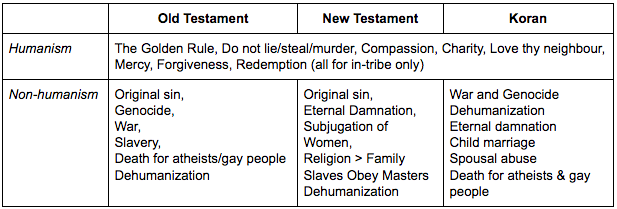
Morality came first. Religion took the credit after the fact, then added dogma to protect itself and gain money and power.
We learned the good parts of religion on the playground. Remember being told “be nice to others” without also being told “because a god will punish you if you’re not”? That worked on your instinctive empathy, not your fear of damnation. And it worked pretty well for most of us!
Religion tells the story like this:
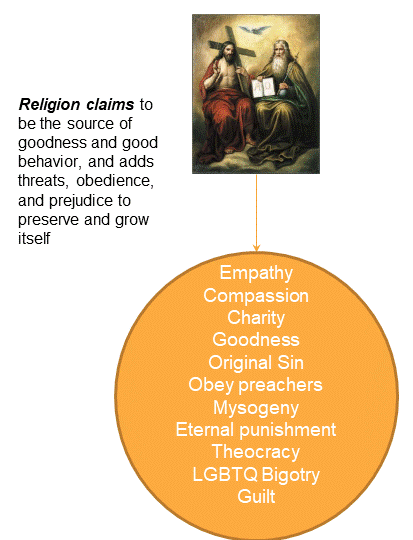
Here’s what actually happened:
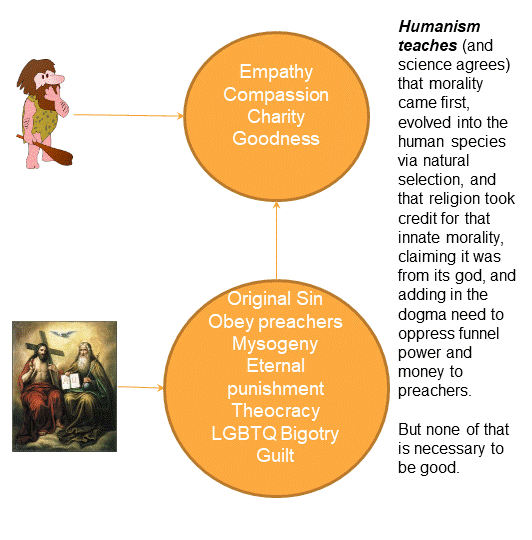
Religion didn’t invent Good, it just stole the credit!
Summary
Religious dogma exploits the outgrouping and dehumanization that evolution built into all of us, holding back moral progress while claiming to be morality’s source. But morality isn’t whatever a god or a preacher says it is. It’s what we as a society decide, and that’s where we find our Practically-objective Good.
To get there, we encourage three ideals:
- Humanization
- Civil discourse
- Forgiveness and redemption
Religions define morality in absolute terms. Humanists see it practically, adjusting to the situation with one goal: reducing suffering and increasing well-being. It’s not truly objective, but it’s close enough to be our line in the sand. We’re open to discussion, and meanwhile we’re building on very firm soil: the Good we had all along, before anyone claimed the credit.