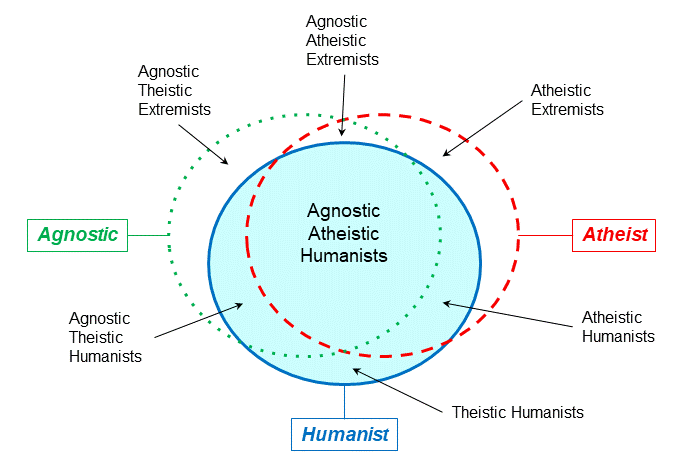
Chances are you’re an agnostic, an atheist, and a Humanist all at once, and you may not even know it. The labels get mixed up constantly, but they answer three different questions: What do you know? What do you believe? And how do you treat people? Let’s untangle them, and then meet the true opposite of a Humanist.
Agnosticism
Agnosticism (a word T.H. Huxley coined in 1869) is the idea that we don’t know everything, and that many things, gods in particular, may not be knowable. An agnostic doesn’t claim absolute knowledge, which leaves room for doubt. And admitting you could be wrong brings humility of thought and non-extreme positions along with it.
Some agnostics say everyone is either agnostic or stubborn, and in a sense they’re right. Nobody can prove with 100% certainty that the coffee cup in their hand isn’t God in disguise. We don’t know everything, so we can’t be absolutely sure of anything!
So what does “certain” really mean? Does “sure” actually mean “almost sure”?
People often use “agnostic” as another word for “atheist,” but that’s a mistake. Agnosticism is about knowledge, not belief. We can’t prove our coffee cup isn’t a cleverly disguised god, but we believe without reservation that the cup is a cup. We call things true or false all the time without full knowledge of the universe.
So we can still hold firm positions based on what we do know. And when new evidence changes our minds, agnosticism and humility shield us from cognitive dissonance and, ideally, make us quicker to adjust. But until Zeus shows himself, we can be very sure (though not 100% positive) that he doesn’t exist, and that your coffee cup is just a cup.
Atheism
Atheism adds the prefix a- (“without”) to theism, belief in a god or gods. So atheism literally means “without belief in a god.” It isn’t a claim of absolute knowledge, or necessarily a flat denial that gods exist (though many atheists go that far).
Agnosticism is the admission that we don’t know everything; atheism is the lack of belief based on what we do know. How firm your atheism is doesn’t matter. The only question is whether you actively believe in a specific deity. If you don’t, you’re an atheist. If you also allow that a deity might be out there somewhere, but you have no reason to believe in one right now, you’re an agnostic atheist.
Where Humanism Overlaps
Humanism is not a religion. It’s a secular philosophy, secular meaning “not religious,” as opposed to “anti-religious.” Like Confucianism, golf, or any other secular pursuit, it’s independent of religion and religious belief. It includes a secular morality, makes no claim to absolute knowledge, and simply works from what we know. So agnosticism and atheism sit on two different scales that overlap, and Humanism sits on a third scale that overlaps both.
That means you can be any combination of atheist, agnostic, and Humanist (as opposed to Social Extremist) and still be perfectly consistent. A believer who lives by humanization and forgiveness is a Theistic Humanist.
On Anti-Humanists, a.k.a. Social Extremists
We all break Humanist ideals sometimes. That doesn’t make us bad, but it isn’t humanistic either. So we need a word for people who routinely act without regard for the Practically-objective Good, whether or not they’ve ever heard of Humanism.
What do you call someone who dehumanizes en masse, ostracizes eagerly and permanently, walls themselves off in echo chambers without caring about the division and harm that does to society, or routinely champions people who behave this way (and shuns those who don’t)?
We call them Social Extremists, because their position is anti-Humanistic by default and by definition.
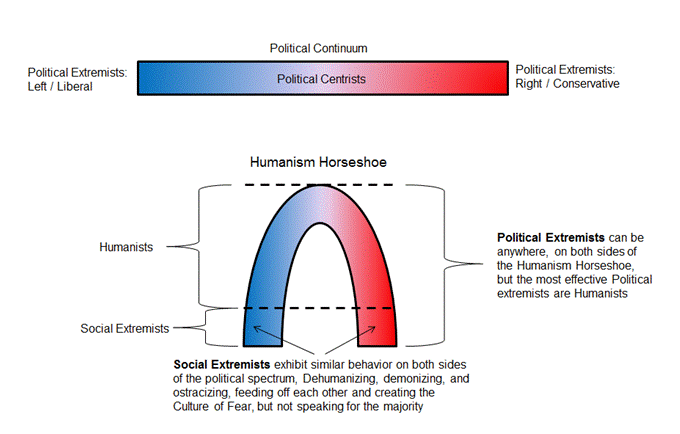
We’re not talking about extreme political opinions. One can (and, we think, should) be an extremist on bodily autonomy, the separation of church and state, and other political questions that bear on our morality. That’s good, productive political extremism. Social extremism is about how we treat people, especially those who disagree with us. (Very often, the two kinds of extremism go hand in hand.)
This isn’t about bad people; we try not to dehumanize. It’s about people so extreme they can’t see the humanity of others or what their behavior does to everyone else. Someone who defies what is obviously good, consistently and even proudly, is blinded by their own extremism and needs our help finding a better way, for themselves and for society.
That makes the Social Extremist, not the believer, the true opposite of a Humanist.
Social extremism is splintering our society and weakening democracy. Ostracization, shunning, and purity tests have become the norm, driven at least in part by rampant dehumanization. That same dehumanization keeps Social Extremists from listening to or forgiving their adversaries (or even their friends), because they prefer echo chambers of people who agree with them perfectly. Algorithmic social feeds (Facebook and Instagram, X, TikTok, YouTube) tend to reward that outrage, and AI-generated content and bots now amplify it further.
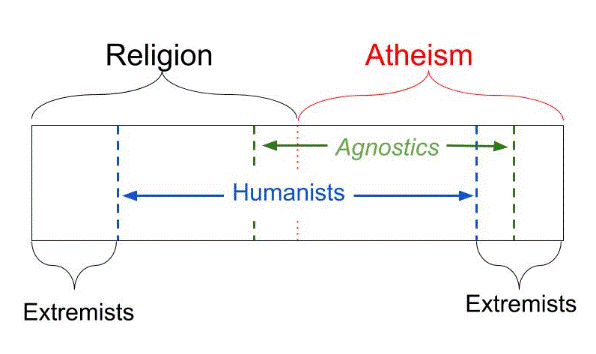
(Figure not to scale)
Here’s the hard part. Social Extremists will treat Humanists far worse than Humanists treat them. They will shun us, dehumanize us, and dismiss us, even as we try to keep them in our lives. They will cast us as the enemy, though we share the same goal, a better Earth, simply because our experiences differ from theirs.
We engage anyway, because we’ve all been extreme at one point or another; it’s partly innate. Extremists become Humanists all the time. With the right communication, real compassion, and a whole lot of humanizing, we can influence people who don’t think they want to be influenced and improve people who don’t think they need improving. We can broaden minds by engaging and embracing, even as they shun and shy away.
That’s what makes Humanism activism, and every extremist who changes strengthens our community. We’re here for the extremists, and for the extremist in all of us. They are complex humans who need to be understood and informed, not demonized and dismissed. Demonizing them would be a socially extreme thing to do!
The Humanism Horseshoe
Social extremism isn’t a liberal problem or a conservative problem; Social Extremists come from every political and demographic persuasion. The far left and far right differ in many ways, but, hard as it is to swallow, their Social Extremists behave the same. Watch two of them argue online: different slogans, same playbook of name-calling, purity tests, and block lists.
The usual political spectrum is a straight line: the farther you go in either direction, the more extreme your position. Bend that line into a horseshoe and you get the Humanism Horseshoe. Political extremists can sit anywhere along it, but their behavior sorts them into Humanists and Social Extremists, and the Social Extremists at the two ends end up nearly touching.
Some of you might be offended by the idea that you, or people like you, behave like the extremists on the other side when you fight for a cause you believe in. It’s true anyway. The point isn’t to offend. It’s to show you how changing your behavior can help you more thoroughly dominate the Social Extremists on the other side, using civil discourse as a weapon, and a verbal thermonuclear one at that.
Summary
The world is full of division and outgrouping, and we don’t intend to add to it. We just want to be clear about who is doing what. Agnostics, atheists, and Humanists are usually the same people, but the words mean different things: one is about what you know, one about what you believe, and one about how you treat people. And extremists aren’t bad people; they usually mean well and deserve the benefit of the doubt. We shouldn’t demonize anyone, even the Social Extremists who demonize us. Instead, we try to understand their point of view and show them how Humanism benefits society, and themselves. After all, every one of us has been the extremist at some point.